

Hero
vsPostHog

OpenPanel vs PostHog

PostHog is a large developer platform: analytics, feature flags, experiments, surveys, error tracking and a data warehouse. OpenPanel does product and web analytics only, with a much smaller script, no cookies by default and a self-hosted setup you can run on one server.

Carl-Gerhard LindesvärdCarl-Gerhard LindesvärdPrices checked Oct 18, 2026

Pick PostHog for an all-in-one developer platform; pick OpenPanel for product and web analytics with a 3 KB script and one-server self-hosting.

Pick OpenPanel if

  • Teams that use PostHog mainly for events, funnels, retention and session replay
  • Sites where script weight matters: storefronts, landing pages, content sites
  • Products that want cookie-free analytics without a consent banner
  • Teams that want to self-host on a single server with Docker Compose

Pick PostHog if

  • Teams that rely on feature flags and A/B experiments with significance testing
  • Teams that want surveys and error tracking from the same vendor
  • Analysts who want to query raw data with SQL (HogQL)
  • Small products that fit inside PostHog's 1M free events a month

The differences that matter

Measured or taken from each vendor's docs in October 2026.

TopicOpenPanelPostHog
Browser script (gzipped)3.3 KB~105 KB (posthog-js dist/array.js)
Cookies by defaultNonelocalStorage + first-party cookie
Cost at 1M events/month$90 (replay included)$0 analytics; replay billed separately past 5K recordings
Cost at 10M events/month$350~$324 for analytics events alone
Self-hostingSupported. Docker Compose: ClickHouse, Postgres, RedisHobby deploy, officially unsupported. ClickHouse, Kafka, ZooKeeper, Redis, Postgres, MinIO
Feature flags, experiments, surveysNoYes

Where PostHog is better

If any of these matter to you, PostHog is the better pick.

Feature flags and experiments

PostHog ships feature flags and A/B tests with significance testing in the same product as its analytics. OpenPanel can break any report down by a variant property, but it has no flag delivery and no experiment statistics.

Surveys, heatmaps and error tracking

PostHog has all three, each with its own free allowance. OpenPanel has none of them, so you would add a separate tool for each one you need.

SQL in the dashboard

HogQL lets you write SQL against your events from the PostHog UI. OpenPanel has a visual report builder. Self-hosters can query ClickHouse directly, but there is no SQL editor in the dashboard.

A free plan for small products

The first 1M analytics events each month are free on PostHog. OpenPanel Cloud has no free plan: you get a 30-day trial, and self-hosting is the free option.

Pricing at real volumes

PostHog is cheaper for small products and roughly the same as OpenPanel at 10M events, if you only count analytics events. The difference is what else gets metered.

Monthly volumeOpenPanelPostHog
100k events$20$0
1M events$90$0
10M events$350about $324 (analytics events only)

OpenPanel

Flat monthly tiers by event volume

You pick an event volume and pay a flat price: $90/month for 1M events, $350/month for 10M. Session replay, dashboards, users and projects are not metered separately. There is no free cloud plan: you get a 30-day trial, and self-hosting is free with no event limit.

PostHog

Usage-based, metered per product

Product analytics is free for the first 1M events a month, then $0.00005 per event up to 2M and $0.0000343 per event from 2M to 15M, so 10M events cost about $324. Session replay, feature flags, surveys and error tracking each have their own free allowance and meter.

Free tier: 1M analytics events and 5K session replays a month

PostHog pricing page

When OpenPanel is the better PostHog alternative

If your team uses PostHog to track events, build funnels and retention charts and watch session replays, and never opens feature flags or surveys, you still carry the rest: a larger script, a heavier self-hosted stack and a separate meter for each product.

The script size difference is large. OpenPanel's web script is 3.3 KB gzipped. PostHog's main browser bundle (posthog-js 1.438, dist/array.js) is about 105 KB gzipped when we measured it in October 2026. On a marketing site or a storefront, that is weight your visitors download before anything else runs.

Privacy defaults differ too. PostHog's JavaScript library stores its state in localStorage plus a first-party cookie unless you change persistence. OpenPanel sets no cookies: it identifies anonymous visitors with a daily-rotating salted hash, so you can run it without a consent banner in most setups.

PostHog is the better choice if you want one vendor for analytics, feature flags, A/B experiments with statistics, surveys and error tracking, or if you want to write SQL against your data. OpenPanel has none of those products, and we would rather you know that before you migrate.
Where OpenPanel fits better

Four situations where the switch pays off.

You only use PostHog for analytics

If your PostHog usage is events, funnels, retention and replay, OpenPanel covers it with one price and one script.

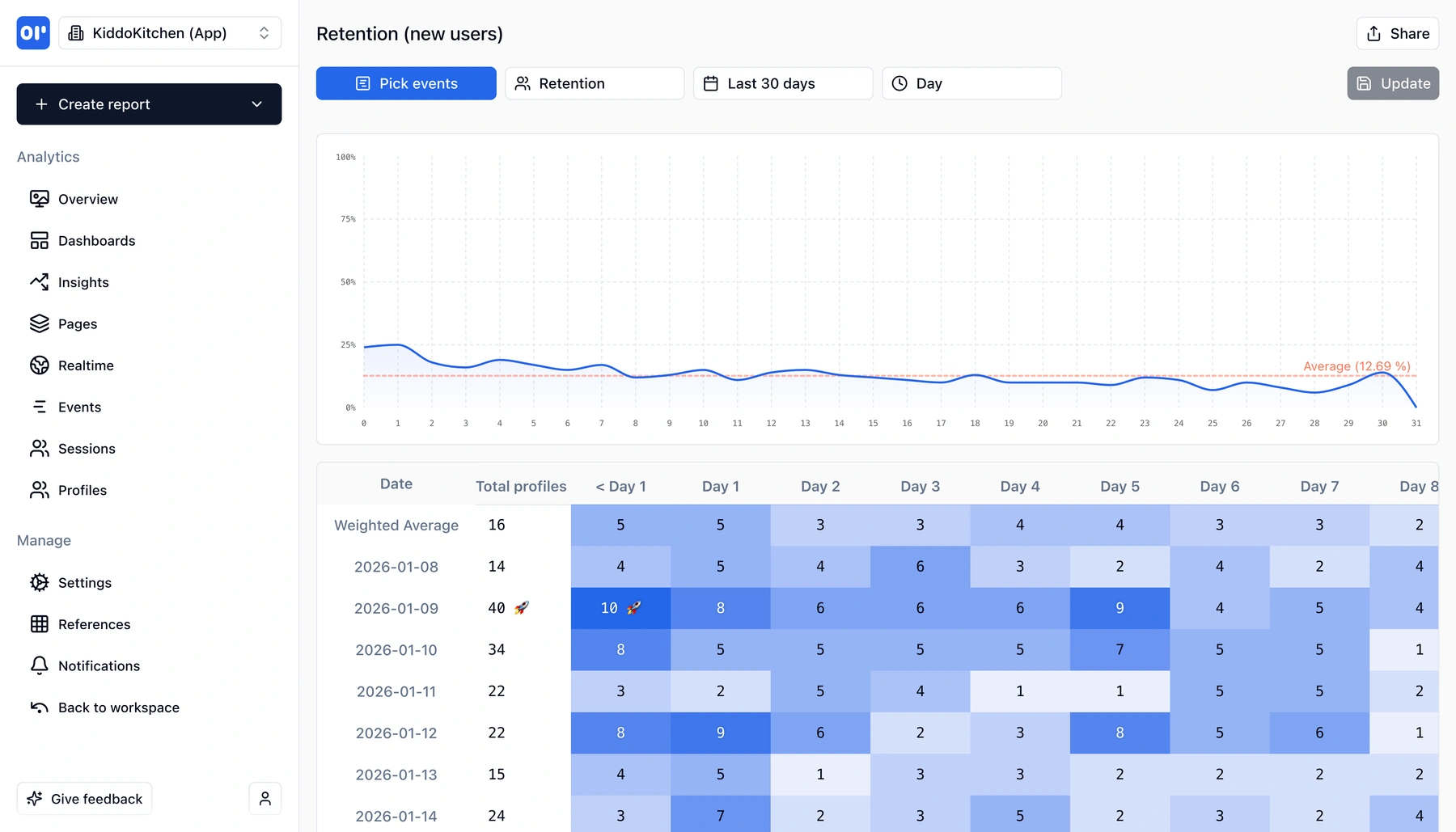
OpenPanel retention report with a daily retention curve and cohort table for new users

You want analytics without a cookie banner

OpenPanel stores nothing in the browser by default. PostHog needs a persistence change, and turning persistence off makes every page load a new anonymous user.

OpenPanel web analytics overview with visitors, sessions, pageviews and bounce rate

Page weight shows up in your Core Web Vitals

Replacing a ~105 KB bundle with a 3.3 KB script is one of the cheaper performance wins on a content or commerce site.

You want to self-host and have support for it

OpenPanel's self-hosted version is the full product on a three-service Docker Compose stack. PostHog's hobby deploy is unsupported and limited to free-plan features.

Technical comparison

For the developer who has to install and run it.

FeatureOpenPanelPostHog
Browser script3.3 KB gzipped (op1.js)
~105 KB gzipped core bundle; replay and other extensions load on topMeasured October 2026 against the live files.
SDKs
  • Web / script tag
  • Next.js
  • React
  • Vue
  • Astro
  • Remix
  • Express
  • Node.js
  • React Native
  • Swift (iOS)
  • Kotlin (Android)
  • Python
  • PHP, Ruby, Rust, Java, Flutter (community)
  • JavaScript
  • React
  • Next.js
  • React Native
  • iOS
  • Android
  • Node.js
  • Python
  • PHP
  • Go
  • Ruby
  • Java
  • Flutter
  • Rust
PostHog has a Go SDK; OpenPanel does not.
LicensePlatform AGPL-3.0, SDKs MIT
MIT, except the separately licensed ee/ directory
Self-hosted stackDocker Compose with ClickHouse, Postgres and Redis
Docker with ClickHouse, Kafka, ZooKeeper, Redis, Postgres, MinIO and CaddyPostHog asks for at least 4 vCPU and 16 GB RAM for its hobby deploy.
Self-hosted featuresThe full product; releases arrive a month or two after Cloud
Free-plan features only; paid-plan features are Cloud-only
Event storageClickHouse
ClickHouse

Moving from PostHog to OpenPanel

The tracking APIs map almost one to one. There is no PostHog importer, so plan to run both tools side by side until OpenPanel has enough history.

Difficulty:easy
Estimated time:An afternoon for the SDK swap; a few weeks of parallel tracking to build history
1

Install the OpenPanel SDK next to PostHog

Add the web script or the framework SDK with your client ID. Keep PostHog running for now.

2

Map your calls

posthog.capture(name, props) becomes op.track(name, props). posthog.identify(id, props) becomes op.identify({ profileId: id, ...props }). posthog.group() becomes op.setGroup().

3

Rebuild the reports you use

Recreate your main funnels, retention charts and dashboards in OpenPanel.

4

Compare numbers for two weeks

Check that event counts and funnel conversion match between the two tools before you trust the new one.

5

Remove PostHog

Drop the PostHog snippet and keep your PostHog project read-only if you still need old data.

SDK Compatibility

Both use named events with properties and an identify call, so most event names can stay as they are.

Historical Data Import

OpenPanel imports from Mixpanel, Amplitude and Umami, not from PostHog. Keep old data in PostHog or export it through their API.

Feature comparison

Where both have a feature, the depth can differ. Notes explain the gaps.

Show all 23 features
FeatureOpenPanelPostHog
Web analytics
Pageviews, visitors, sessions, bounce rate
Referrers and UTM breakdowns
Realtime view
Product analytics
Custom events and properties
Funnels
Retention and cohort tables
User flows (sankey)
Saved cohorts as report filters
Group (B2B account) analytics
Revenue tracking
SQL queries on raw data

PostHog has HogQL. OpenPanel has a visual report builder; self-hosters can query their own ClickHouse directly.

Beyond analytics
Session replay

OpenPanel replay is opt-in, loads as a separate script and has no per-recording meter.

Feature flags
A/B experiments with significance

In OpenPanel you can break any report down by a variant property, but there is no experiment engine or statistics.

Variant breakdowns only
Surveys
Error tracking
Heatmaps
Privacy and hosting
Cookie-free by default
EU cloud hosting

OpenPanel Cloud runs in Germany. PostHog offers an EU region.

Supported self-hosting

PostHog's own docs call self-hosted deployments officially unsupported.

Data in and out
Export API
Slack, Discord and webhook alerts
MCP server for AI assistants

Questions about switching from PostHog

Short answers, with the trade-offs left in.

Related resources

Explore more comparisons and guides to help you choose the right analytics tool.

Try it on your own data

Try OpenPanel free for 30 days. You won't be charged unless you pick a paid plan.

Start a 30-day trial